|
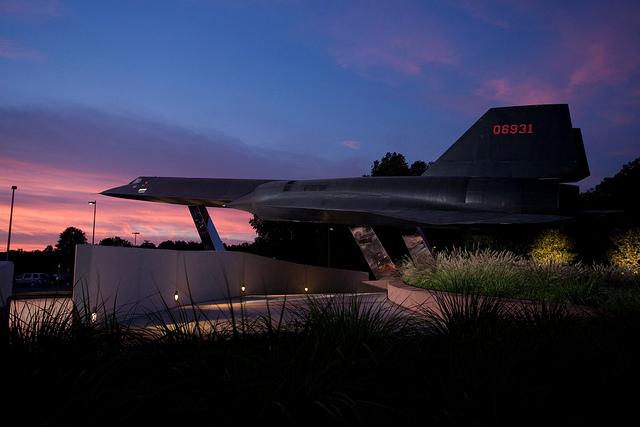
CIA developed the highly secret A-12 OXCART as the U-2’s successor, intended to meet the nation’s need for a very
fast, very high-flying reconnaissance aircraft that could avoid Soviet air defenses. CIA awarded the OXCART contract to Lockheed
(builder of the U-2) in 1959. In 1965, after hundreds of hours flown at high personal risk by the elite team of CIA and Lockheed
pilots, the A 12 was declared fully operational, attaining the design specifications of a sustained speed of Mach 3.2 at 90,000
feet altitude. The A-12 on display at CIA Headquarters—number eight in production of the 15 A-12s built—was the
first of the operational fleet to be certified for Mach 3. No piloted operational jet aircraft has ever flown faster or higher.
January 2013 - Georgia reaches for the stars
Georgia is reaching for the stars --- and outer space --- with a newly announced "space port" on a 4,000-acre patch of piney
swamp along the state's southeastern coast. Camden County officials are touting a NASA-like launch pad for rocket ships to
ferry scientists, satellites and tourists into the skies.
Far-fetched? Maybe. But Georgia already plays a significant role in the nation's expanding aerospace industry. The Southeast,
in fact, is becoming a prime destination for airplane manufacturers, parts suppliers, maintenance shops and even space exploration.
And, not unlike the southern migration of the nation's automakers, aerospace companies are shifting production from the Midwest
(and West) and Europe to the Carolinas, Georgia, Alabama and Florida. Cheap land and labor, and a bucketful of financial incentives
and tax breaks, attract Boeing and Airbus as readily as they did Kia and Caterpillar.
Roughly 23,000 Georgians build planes or parts, according to a draft report prepared by Georgia Power, and the industry is
expected to grow by 16 percent during the next five years. About 60,000 others work for the military, Delta Air Lines, Hartsfield-Jackson
International Airport and other aerospace-related industries, state development officials say.
Many aerospace jobs, though, could be jeopardized by impending Department of Defense budget cuts and the still-weak global
economy. Lockheed Martin announced recently the transfer of 560 jobs from Marietta to Texas, another cost-cutting move for
the F-22 Raptor jet fighter.
"The impacts on both DOD and research and development activities are going to be significant," said Robert Braun, a professor
of aerospace engineering at Georgia Tech. "Cutbacks in R&D hurt economic development. This is research that creates our future,
our national security, our economic and technological leadership."
But Braun, the former chief technologist for NASA, marvels at Georgia's diverse aerospace industry. Military and commercial
aircraft. Unmanned aerial vehicles (drones). Maintenance, repair and supply. Air transportation, including the world's busiest
airport.
And education. Georgia Tech, after all, is home to the nation's fourth-best graduate aerospace engineering program, according
to U.S. News & World Report. Middle Georgia College in Eastman --- "Georgia's main aviation campus," according to state promotional
literature --- offers degree programs in air traffic control, airport management, avionics and more.
Middle Georgia is also where Nick Alley test-flies drones. Alley and a handful of engineers design and build unmanned aerial
vehicles (UAVs) in Kennesaw. His company, Area-I, has received $170,000 in grants from the state of Georgia, as well as sponsorship
to legally fly the drones at Middle Georgia College.
Georgia "is a great aeronautical environment, but not necessarily a mecca for UAV work," said Alley, who has contracts with
the Pentagon and NASA. "The state wants to change that. We wouldn't be able to function without state support. They've been
a key part of us being able to stay here and grow the company."
Aerospace is a $10 billion a year business in Georgia, responsible for 2.4 percent of the state's GDP, according to a 2010
study by audit and consulting firm Deloitte. Airplane and parts exports topped $4.7 billion that year, the U.S. Census Bureau
said. Georgia even added aerospace jobs --- average salary: $73,234 --- during the recession, a welcome trend as unemployment
hit double-digits statewide.
About 500 aerospace manufacturing, parts, maintenance and service companies dot Georgia, most located in metro Atlanta. Delta
and Lockheed garner top billing. Georgia Power lists other local aeronautical stalwarts: Aircraft Services International (450
employees, Fulton County); Universal Alloy (350, Cherokee); L-3 Communications (300, Fulton); Barco (243, Gwinnett).
Robins Air Force Base in Houston County employs 25,000 military and civilian personnel and serves as home base for an air
wing and an air logistics center. Gulfstream builds jets in Savannah with 6,000 employees.
"We have some big anchors --- Delta, Lockheed, Gulfstream and Warner Robins," said Steve Justice, who runs the Georgia Center
of Innovation for Aerospace, a state economic development agency. "You tend to see a lot of companies congregate around those
anchors, just like a mall."
Georgia's aerospace industry, though substantial, is commensurate with its ranking as the nation's 10th-largest economy. Alabama,
for example, derives a larger share of its GDP from aerospace. Although NASA no longer flies the shuttle, Florida leads the
race to space.
Neighboring states too have recently landed some major airplane manufacturers. European plane maker Airbus announced in July
it would build a $600 million factory to make jets in Mobile, Ala. Seattle-based Boeing employs 6,000 at a new plant in North
Charleston, S.C. Wichita's Spirit AeroSystems opened a fuselage plant in North Carolina two years ago.
"The whole Southeast has been growing in aerospace, but we've been growing the fastest," said Justice. "And if you're an aerospace
company that wants to do business with Boeing and Airbus, we are well-positioned in Georgia."
Justice, like professor Braun, said the state is uniquely situated to join the space race. The proposed spaceport near St.
Marys is remote and close to the open waters of the Atlantic Ocean, a key consideration when launching unproven rockets. Justice
said "several (aerospace) companies out there are talking to Georgia" about the Camden County site.
"It's a long way off from reality," Braun said. "But it could be the place where the commercial space industry launches from.
It's all very interesting."
Source: http://www.avionics-intelligence.com/news/2013/01/06/ga-reaches-for-the-stars.html
November 2012 - Analysts keep close eye on China's mystery space plane
Last year several Chinese media outlets reported a test flight of the Shenlong space plane that apparently included its airdrop
from an H-6 bomber. But the nature of the Shenlong project's testing, as well as what the robot vehicle truly represents,
remains sketchy.
Link courtesy of Space on NBCNews.com
October 2012 - Amateur Radio and Aviation Education XI
Space Station Deploys Five CubeSats
October 2012 - FUN: Stunning Fighter Pilot Training Footage
Link courtesy of www.ebaumsworld.com
December 2011 - Test Pilot Joe Kittinger
Joe Kittinger is not a household aviation name like Neil Armstrong or Chuck Yeager. But what he did for the U.S. space program
is comparable.
Read more
May 2011 - Transatlantic Amateur Radio Balloon Launch
Read more
April 2011 - Our Future In Space Doesn't Look Bright
Jonathan Coopersmith, associate professor in the Dept. of History at Texas A&M, writes that since we landed on the moon "it's
been all downhill for human spaceflight."
Read more
- Article courtesy of The Birmingham News.
August - Can America's youth be persuaded to take up tech?
There's a pressing need for young people in the U.S. to consider careers in science and technology, particularly in aerospace,
says Marion Blakey, chief executive officer of the Aerospace Industries Assn. Read more
- Courtesy of businessweek.com/technology.
July - Where's Your Flying Car?
Terrafugia's "roadable aircrafts," which can zoom around clouds as easily as they zoom around the block, are set to
take off late next year. Read more - Courtesy of smartertechnology.com.
May - 10 Classic Photos from Hubble
Last month marked the 20th year of use for the Hubble Space Telescope. Although it is due to be replaced by the infrared James
Webb Space Telescope around 2014, the Hubble has allowed NASA scientists to peer farther into our universe than ever before,
and the results have been awesome. Here are 10 classic Hubble shots from 20 years of exemplary service. View slideshow - Courtesy of eweek.com.
March - Photo slideshow of USA military hardware
This document has 46 great photos of aircraft, ships other equipment in action. The photos are sharpest at 100% magnfication.
View in a new window (pdf)
March - World War II Female Pilots Honored With Gold Medal
A long-overlooked group of women who flew military aircraft during World War II were awarded the Congressional Gold Medal
on Wednesday. Read full story - Courtesy of National Public Radio. Related stories are available at the bottom of the article.
February - The SR-71 Blackbird
On 22 December 1964, Lockheed test pilot Bob Gilliland flew the first flight of the SR-71 (#950) at Palmdale, CA., flying
for over one hour in excess of 1,000 MPH (MACH 1.5 at 50,000 feet).
Click on this .pdf to enjoy a recounting of just one of the lucky few to pilot this phenomenal aircraft.
January - Sullenberger simulation
Enjoy this YouTube video showing a flight simulation of USAIR Capt. Sully Sullenberger departing New York Laguardia and landing in the Hudson River.
(runs about 7 1/2 minutes with sound)
December
Teachers and administrators in all elementary and secondary grades are keenly aware of the importance of their students’
solid foundation in the basics … math, sciences and history.
The perception, however, that technology and the arts are completely separate was seriously attacked nearly fifty years ago
by C. P. Snow (both a novelist and a scientist) in his book The Two Cultures and the Scientific Revolution. Mr. Snow
noted that the purely "practical" approach led to both an intellectual and creative loss to our society, arguing that the
lack of communication between the sciences and the arts would lend cause to a spiritual and visionary loss as well.
The theme of the 2008 program, "Design an Aviation Stamp" was chosen to give the students an opportunity to learn through
research, enjoy the expression of their artistic abilities and consider the relationships between the "basics" and the aviation
education curriculum as students and their mentors interact through the learning medium to arrive at the student’s chosen
design.
The "simple" lesson approach:
• One approach has teachers providing students with information about aviation and aerospace heroes and heroines. Each
student is guided in the development of a short outline describing their theme choice, and then enjoys the transformation
of the written structure into an artistic, creative equivalent.
• In another, students were supplied with topic sentences such as "In rural America, agricultural aviation is vital
to crop yield while urban America knows that airport transportation brings overall community success." Students were then
asked to write additional sentences to support their chosen theme and share their ideas in a "workshop" approach as the "practical"
was transformed into the romantic joy of artistic creativity.
• What are the different types of aircraft? Big transport planes that fly people, mail, animals, food, fresh flowers,
and all sorts of other stuff all over the world – and from place to place in the United States. Helicopters can take
off and land vertically and they are used as an “air taxi” to transport people from one location to another where
landing space is limited. Helicopters are used to saves lives by taking people to hospitals for medical care; helicopters
are used as “air cranes” for construction to help lift steel and other heavy items necessary to build bridges
and other complex structures; and they are used by the military for various missions. What are some other types of aircraft?
EDUCATOR NOTE:
If you or your students would take the extra time, our panel of judges would welcome a note included with each art submission
to help them "see" what the child is seeing in his or her artwork.
Can you think of other uses of the aircraft in your community?
Does your library have books about airplanes?
Have an Aviation Education Day and invite a speaker – call the local airport manager and ask for a recommendation, or
invite a pilot or other aviation career person to be a guest in your classroom.
Please keep the feedback coming in and we will continue to post your comments in the Teachers Lounge where we can all share
ways to use art and science to enhance learning through creative expression.
Looking forward to hearing from you soon!
Frank G. Brewer, III
Representative, BTAEA
|